Ego2Robot: Scalable Robot Data Synthesis from Egocentric Human Data

Ye Wang1,2,∗, Pei Lin2,3,4,∗, Xiong-Hui Chen2,∗, Haoqi Yuan2, Zhixuan Liang2,
Yiyang Huang2, Anzhe Chen2, Zixing Lei2, Jie Zhang2, Tao Zhang1, Haoyang Li2,
Tong Zhang2, Chenxi Xiao3, Ziyuan Jiao4,5, Qin Jin1,†

1AIM3 Lab, Renmin University of China    2Qwen Team, Alibaba Inc.
3ShanghaiTech University    4Beijing Institute for General Artificial Intelligence (BIGAI)
5Beijing University of Aeronautics and Astronautics

Equal contribution   Corresponding author

Overview Video

§Abstract

Learning generalizable robot manipulation policies requires large-scale and diverse demonstration data. Egocentric human manipulation videos offer rich scene and task diversity, and prior work has shown that retargeting and rendering such videos into robot-format data can yield effective per-task policies at small scale. However, whether this approach can provide pretraining benefits for vision-language-action models at scale remains unexplored.

We present Ego2Robot, a scalable pipeline that converts egocentric human manipulation videos into robot training data through action retargeting, robot-arm visual synthesis, and multi-level quality curation. Ego2Robot supports both curated datasets and in-the-wild videos, producing 18,561 hours of robot training data spanning 15 robot morphologies, making it the largest ego-to-robot dataset to date. To evaluate generalization, we extend RoboTwin 2.0 with disentangled perturbation axes covering visual appearance, scene layout, embodiment morphology, and task semantics. Experiments show that joint pretraining on Ego2Robot-synthesized and robot data consistently improves out-of-distribution generalization across multiple perturbation types, with benefits validated on real-robot deployment.

1The Ego2Robot Pipeline

Given egocentric video of human hand manipulation, the pipeline produces embodiment-specific robot training data in three stages. It supports two input paths: Path A uses ego datasets with existing hand-pose annotations; Path B estimates hand poses from raw video (WiLoR per-frame reconstruction + DynHaMR temporal optimization), then both paths share a unified pipeline that renders any of 15 morphologies in parallel.
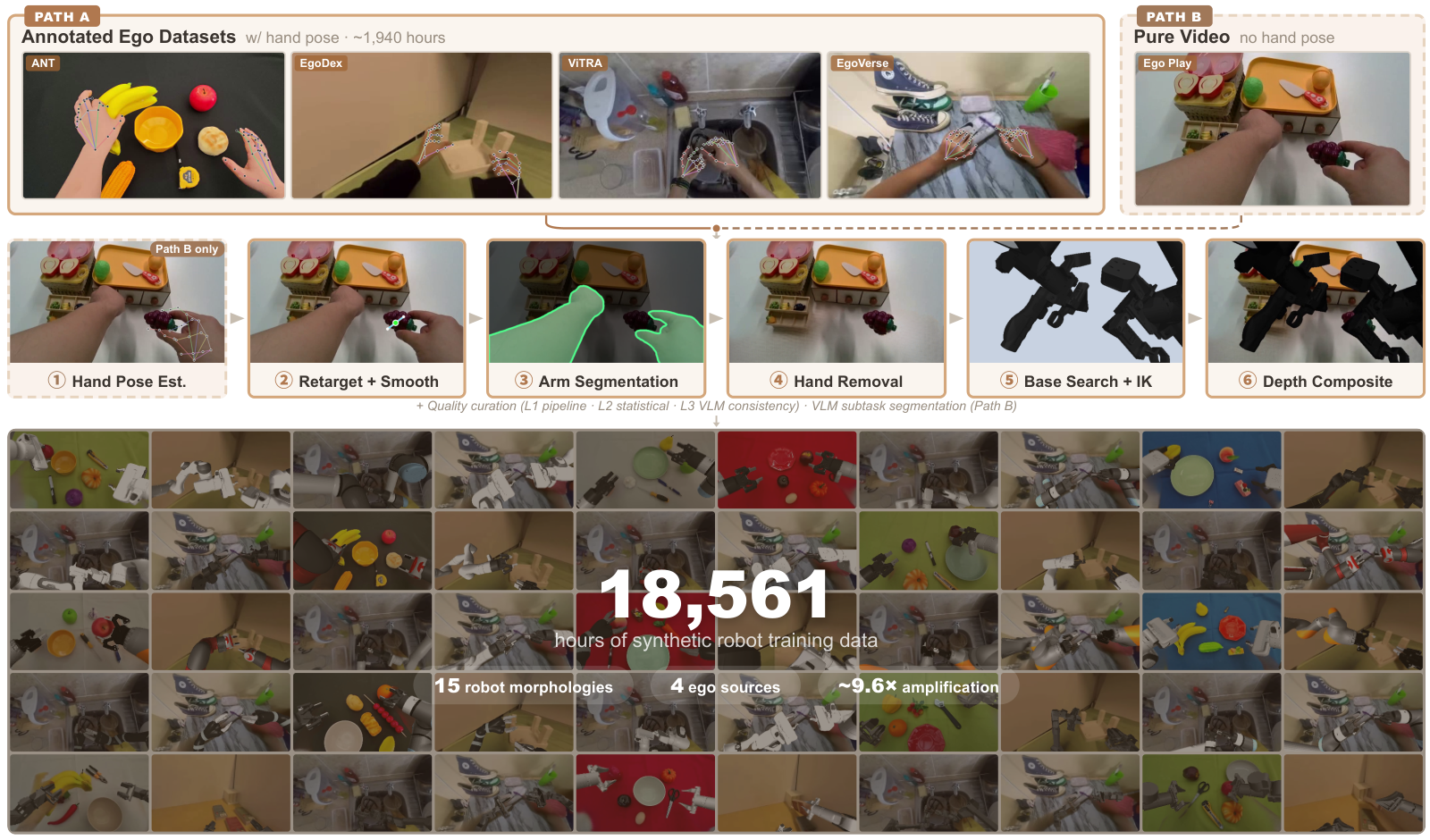
Ego2Robot pipeline overview
Overview of the Ego2Robot pipeline: Path A / Path B inputs, then shared action alignment, visual alignment, and quality curation.
Stage 1

Action Alignment

Retarget hand keypoints (thumb, index/middle tips, wrist) into gripper TCP, width, and orientation; smooth with Savitzky–Golay + SLERP.

Stage 2

Visual Alignment

SAM 3 arm segmentation → ProPainter hand removal → robot base-pose search → IK solving → depth-aware compositing into the inpainted scene.

Stage 3

Quality Curation

Three levels: L1 pipeline-internal (IK failures, collisions, outliers), L2 statistical (extreme values, discontinuities), L3 VLM video–action consistency.
2Data at Scale

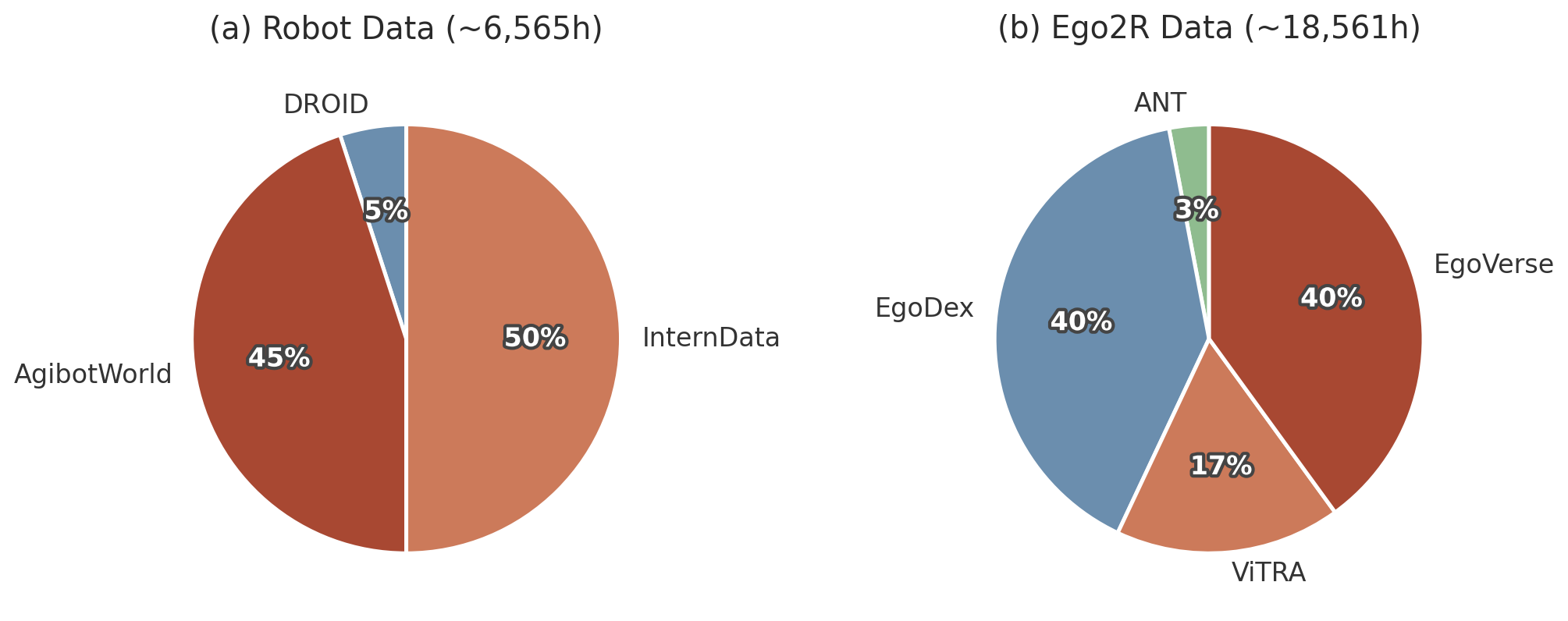
Applied to four egocentric sources — ANT (7h, in-house), EgoDex (732h), ViTRA (249h), and EgoVerse (954h), ~1,940h total — and rendered across 15 morphologies to yield 18,561h of synthetic robot data, co-trained with ~6,565h of real robot data (DROID, AgibotWorld, InternData).

Data source composition
Pretraining data composition. Slices show per-source sampling weights (training mix); totals are ~6,565h robot and ~18,561h Ego2R.
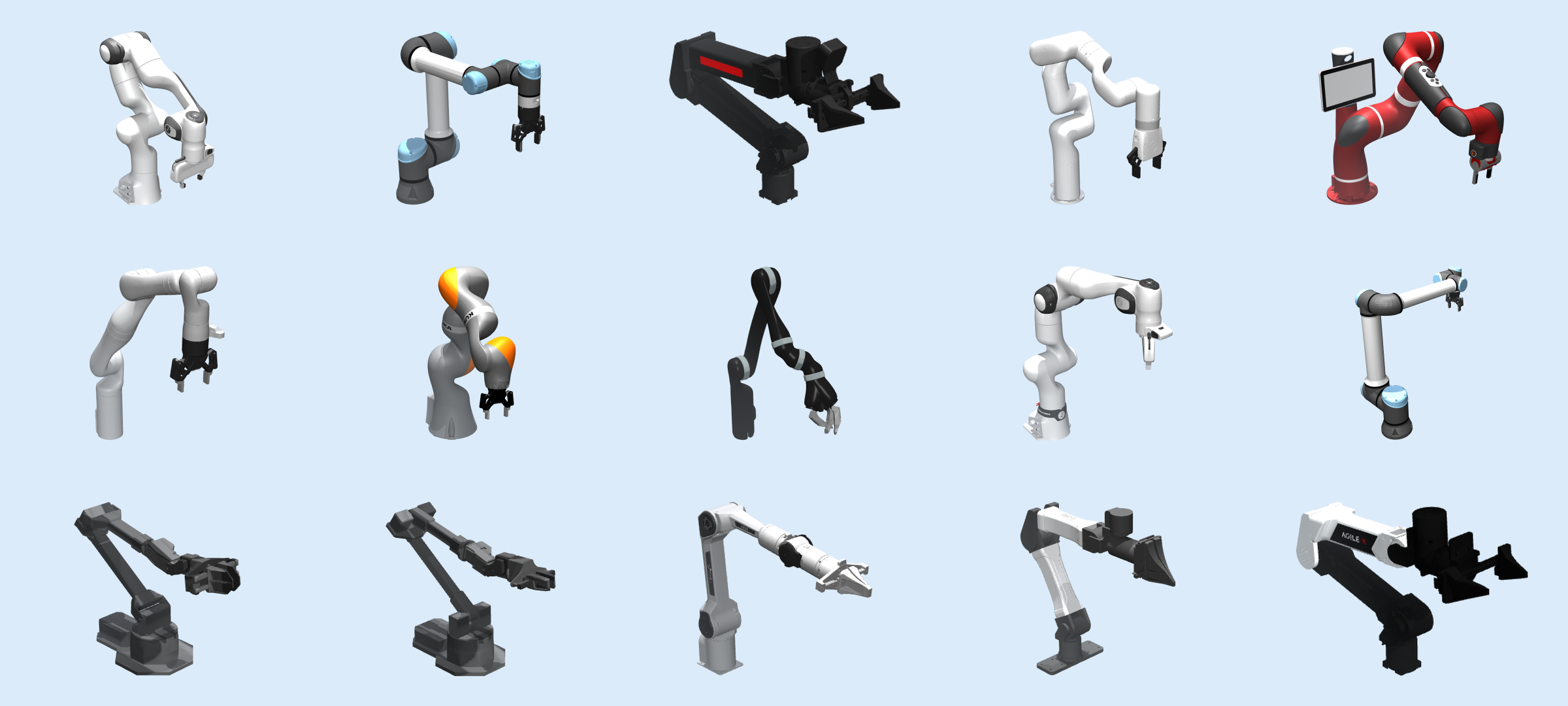
15 robot morphologies
The 15 supported robot morphologies.

3Disentangled Evaluation Framework

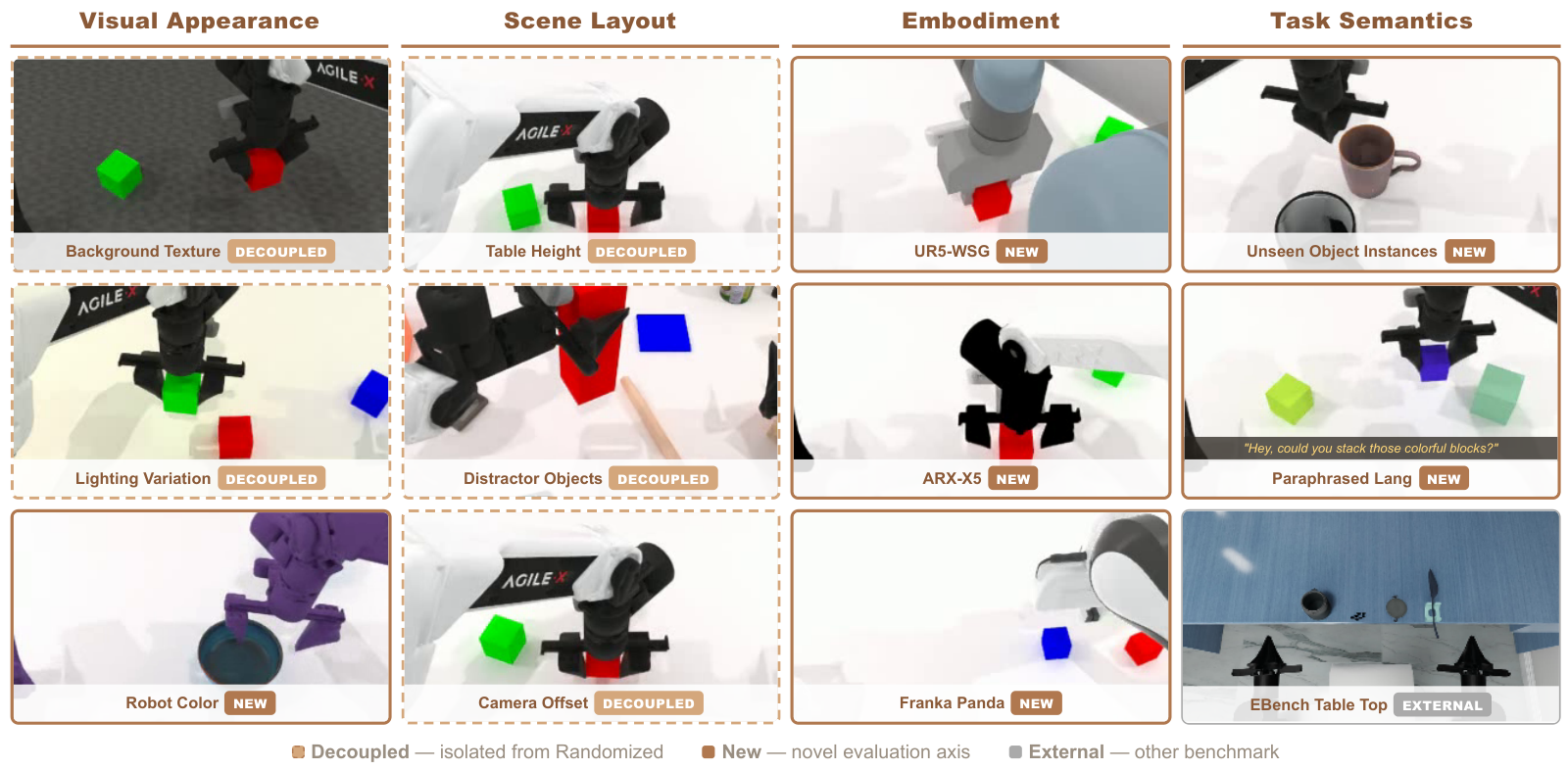
Existing protocols bundle many distribution shifts into a single OOD score. We extend RoboTwin 2.0 with 11 independent perturbation settings plus the external EBench (higher-mounted camera, closer to the egocentric view), decoupling four generalization axes.

Evaluation framework: four generalization dimensions
12 settings across four axes. Dashed = decoupled from bundled randomization; solid = new axes; gray = external (EBench).
Axis 1

Visual Appearance

Background, lighting, and robot-color shifts.

Axis 2

Scene Layout

Table height, distractors, and camera offset.

Axis 3

Embodiment

Zero-shot to UR5, ARX, Franka (vs. Aloha-Agilex).

Axis 4

Task Semantics

Unseen objects (50 tasks) and 505 paraphrased instructions.

4Main Results

A VLA (Qwen3.5-4B backbone + Diffusion Transformer action head, 32-step camera-frame relative EEF chunks) is pretrained under four configurations (robot-only, plus Ego2R:robot at 1:3, 3:1, 1:1), finetuned on RoboTwin's 50 clean-setting tasks (Aloha-Agilex), and evaluated per perturbation. Every pretraining run uses identical hyperparameters (200K steps × batch 12 × 8 GPUs) and thus processes the same ~19.2M frames, so comparisons are fair regardless of dataset size.

PretrainingCleanRandVisualSceneEmbodyTaskEBench
Robot-only62.250.961.452.923.846.239.6
Ego2R + Robot (1:3)61.451.061.252.521.949.547.4
Ego2R + Robot (3:1)64.149.262.754.328.251.651.7
Ego2R + Robot (1:1)68.153.567.356.927.254.149.8

Success rate (%) on RoboTwin 2.0 (per-dimension) and EBench. Bold = best in column; green = >5% gain vs. Robot-only.

Per-perturbation breakdown

PretrainingBGLightColorHeightClutterCameraARXUR5FrankaObjLang
Robot-only66.658.259.460.148.350.444.120.27.029.363.1
Ego2R+Robot (1:3)65.058.360.358.649.349.643.717.64.536.862.2
Ego2R+Robot (3:1)65.560.961.862.049.251.647.631.45.640.063.1
Ego2R+Robot (1:1)70.365.865.862.452.056.351.225.05.339.668.5

Per-perturbation breakdown (%). Columns: Visual (BG, Light, Color), Scene (Height, Clutter, Camera), Embodiment (ARX, UR5, Franka), Task (Obj, Lang). Bold = best in column; green = >5% gain vs. Robot-only.

5Ablations: Pipeline Value & Morphology Scaling

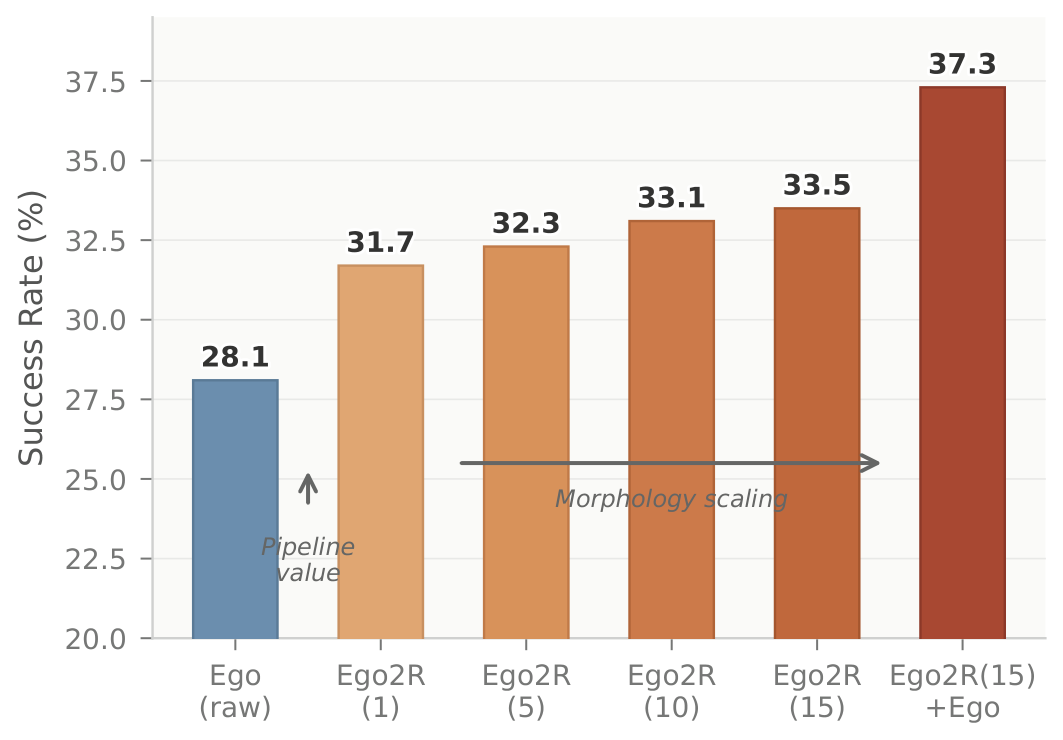
Ego-only pretraining (no robot data) isolates the pipeline's contribution. Training on raw ego alone reaches only 28.1% on RoboTwin Randomized; processing through the pipeline (single morphology) lifts it to 31.7% (+3.6). Scaling 1→15 morphologies improves to 33.5%, and adding raw ego alongside 15-morphology data jumps to 37.3% — raw ego acts as a 16th "morphology".

Pipeline value and morphology scaling ablation
Success rate on RoboTwin Randomized under ego-only pretraining.

6Real-Robot Experiments

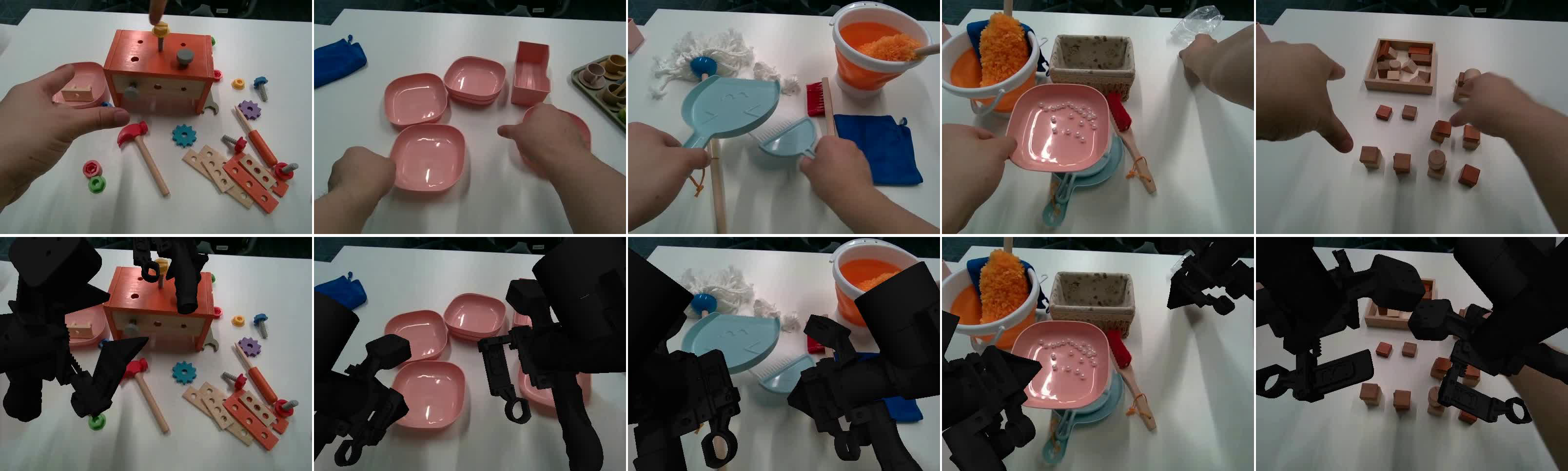
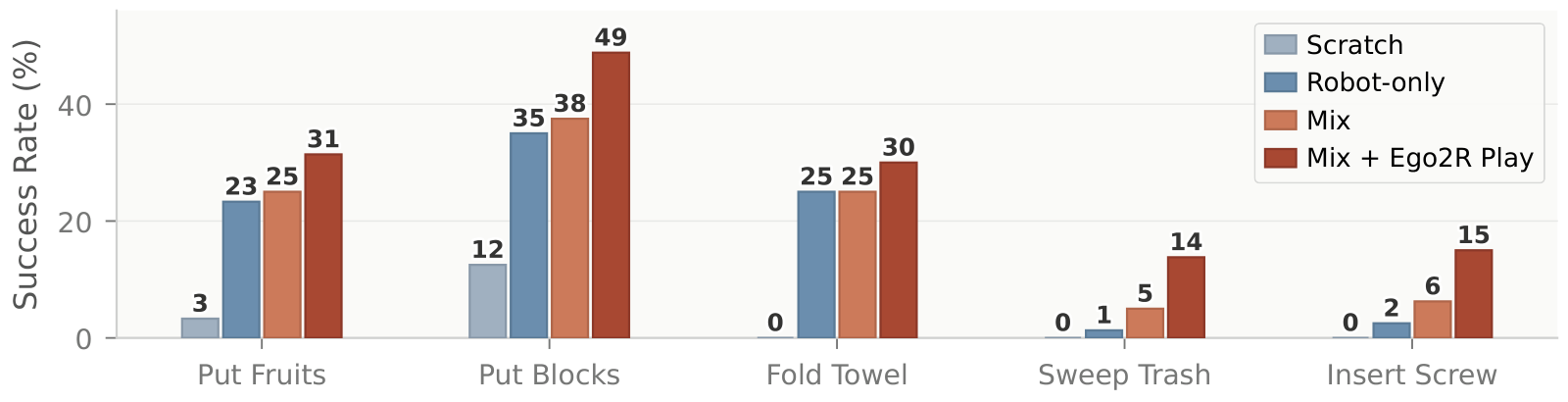
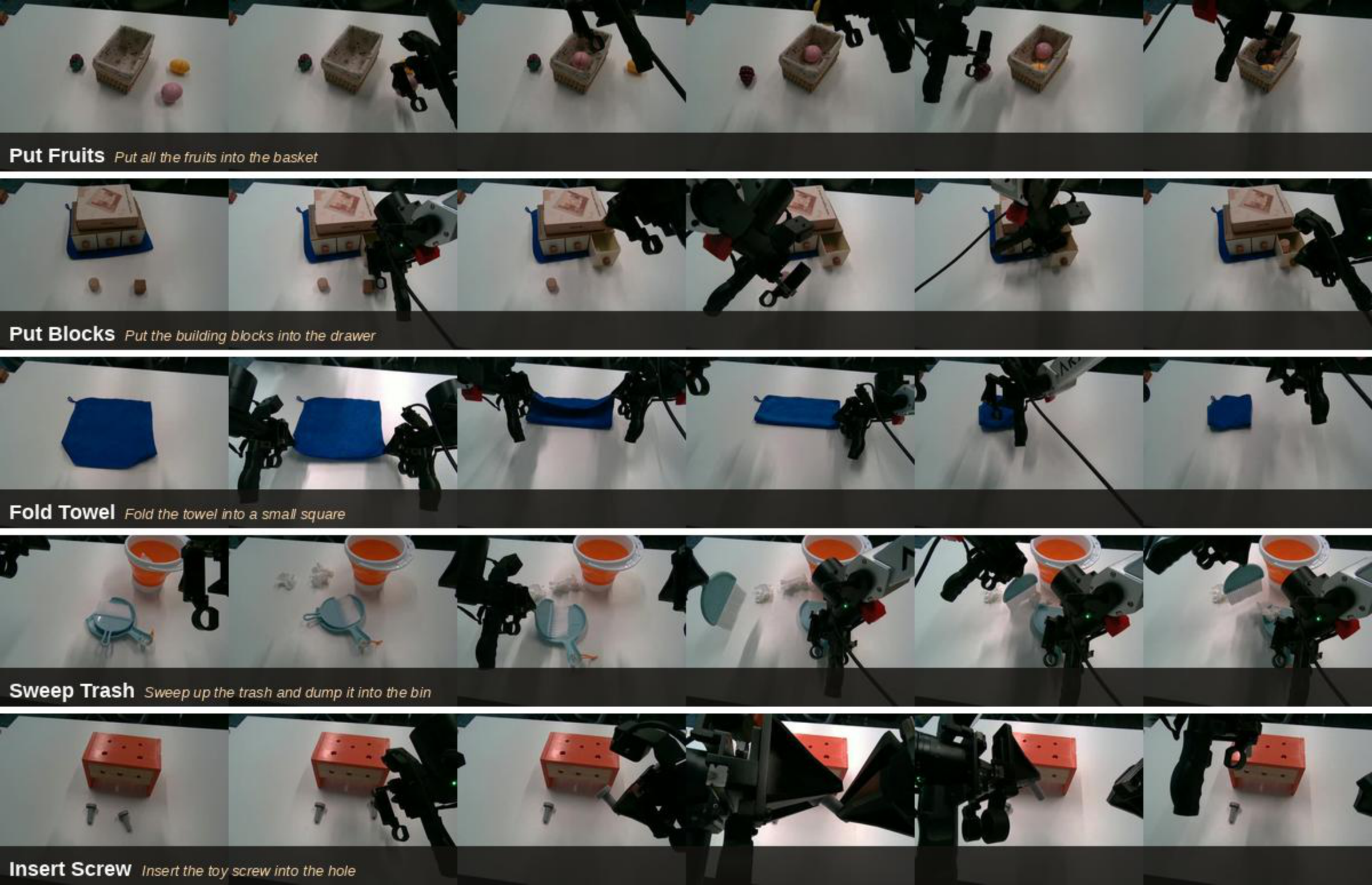
On an ARX ACone platform across five long-horizon tasks, in a few-shot regime of only 20 teleoperated demonstrations per task, we compare Robot-only, Mix (Ego2R+Robot 1:1 pretraining), and Mix + Ego2R Play (same pretraining, but with pipeline-converted ego-play demonstrations mixed into the finetuning data — synthesized from casual first-person recordings of hand manipulation in the scene, ~7 min each). Mix + Ego2R Play is best on all five tasks.

Ego2Robot real-play synthesis gallery
Ego play videos converted into ACone-specific synthetic demonstrations.
Real robot success rates across five tasks
Success rates (%) on five tasks on the ARX ACone platform.
Real robot rollout key frames
Key frames from the five real-robot evaluation tasks.